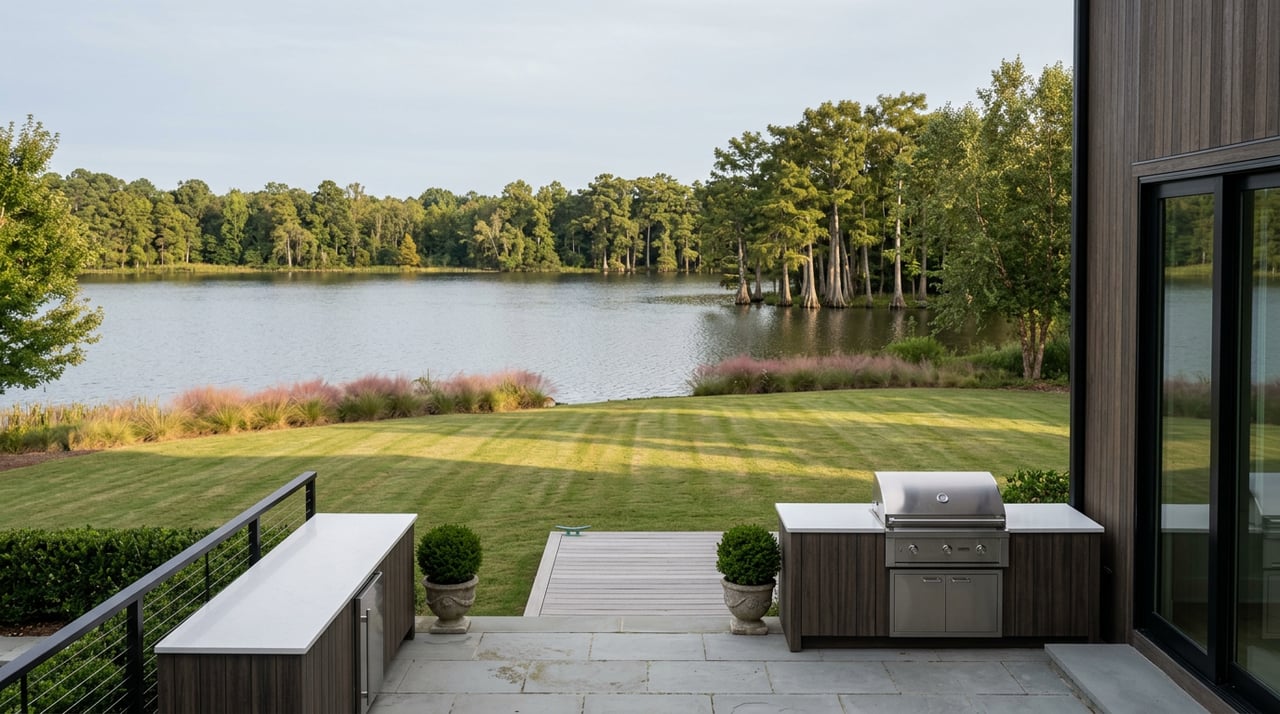
Pull into the dock at Lake House Wine Bar and Grill on a Friday evening and you will find pontoon boats parked three deep against more than twenty slips, engines off, coolers already open. Nobody out there ran a long route to get here. Most of them idled over from a cove ten minutes away, because this year, for a lot of Lake Norman regulars, the destination stopped being the open water and started being wherever the water meets a patio.
That shift did not happen by accident. It happened because 2026 handed the lake two things at once: a drought that made the water itself harder to use, and the busiest stretch of waterfront restaurant openings the lake has seen in years. Those two facts usually would not share a sentence. This year they explain each other.
What the drought actually did to a day on the water
Lake Norman spent most of this summer sitting around 95 feet, roughly 3.5 feet below its seasonal target, according to reporting from Cornelius Today in early August. Rain came in bursts rather than soaking spells. Five inches fell in late May, then only two in June, five again in July, and about two so far in August, mostly from fast-moving, localized storms rather than the kind of steady, region-wide rain that actually refills a reservoir.
Brett Hartis, a water resources manager for Duke Energy, put the timeline in blunt terms when Cornelius Today asked how long the recovery would take. "It took a long time to get into this level of drought, and it will take a long time to get out of it," he said. The Catawba-Wateree basin has been trending dry since October 2024, in the wake of Hurricane Helene, and roughly 70 percent of the months since then have received less than half their normal rainfall. Groundwater is depleted enough that a lot of the recent rain soaks straight into dry soil instead of running off into the lake, which is why a few good storms this summer barely moved the needle on the six-month streamflow averages that help set the region's official drought stage.
You can see the practical version of that at Blythe Landing. Mecklenburg County's current boating advisory lists two of the park's six ramps as open, while all four ramps at Ramsey Creek Park a few miles up the shore are running normally. Same lake, same summer, different ramp math depending on which cove you launch from. If you trailer a boat and haven't checked before a weekend trip, that gap is the kind of detail that turns a Saturday morning into a wasted drive.
Demand didn't drop. It just found a shorter route to the water
Here's the part that would surprise anyone assuming a bad water year means a quiet lake. It didn't. Record heat this July sent people to Lake Norman anyway, drought or not. Martin Cagle, owner of Ride Wake and Surf Co. in Mooresville, told Spectrum News 1 that this was probably the company's best summer in eight years, with highs in the low hundreds and heat indexes above 101 driving demand even as lower water levels made some of his pickup spots harder to reach. He said the shallow water had created new hurdles behind the scenes, but hadn't slowed business down.
Add rising fuel costs to that picture and the incentive to stay close gets sharper. Boat gas at one Lake Norman marina was running about $5.70 a gallon this spring, roughly a dollar higher than normal, a jump Spectrum News 1 tied to the war in Iran driving up fuel costs nationally. Fill a tank on a busy day and you're looking at $450 to $500, according to an employee at Carolina Cruising Charters, a boat rental company on the lake, who spoke to the station back in April. A full tank used to buy a long afternoon exploring coves on the far side of the lake. This year it bought a shorter trip, which is exactly the kind of arithmetic that makes a ten-minute idle to a dock with a full bar sound a lot more appealing than a 45-minute cruise to nowhere in particular.
The waterfront filled in right when people needed it to
That's the mechanism. The lake got less forgiving to explore, fuel got more expensive to burn, and the businesses that filled the gap were the ones you could reach without much of either.
The biggest of them sits at 1459 River Highway in Mooresville, where Vitale Hospitality Group turned the long-shuttered Queens Landing property into Vitale Lakeside. The site had sat dark since the summer of 2023. The new build is a $3 million project with a 9,000-square-foot ground-floor restaurant serving seafood, burgers, pizza and steak, a rooftop stage, and 38 boat slips built specifically so you can tie up without ever touching a car. The signature detail is the floating bar out on the water itself, which means the lake is the room rather than the view from one. Upstairs, a second-floor lounge called Bonnie & Clyde's adds a more upscale option, with a DJ booth and a VIP lounge for anyone who wants the evening to run past dinner.
Down the shoreline, the old Waterman's space is becoming Chili Willi's, a Tex-Mex concept moving into a spot that already had the waterfront layout built in. And Lake House Wine Bar and Grill at 18665 Harborside Drive in Cornelius, rebranded a while back from Port City Club, has quietly become the lake's most dock-accessible sit-down option, with more than twenty boat slips that make pulling up by water genuinely easier than finding parking by land.
None of these openings needed the lake to be full. They needed the shoreline to be worth the short trip, and this year it was.
What's still ahead before the water turns cold
The calendar backs this up too. Lake Norman's Laketoberfest returns to Bailey Road Park in Cornelius this October for its fourteenth year, hosted by Cornelius Parks and Recreation with proceeds benefiting Lake Norman Wildlife, a local chapter of the North Carolina Wildlife Federation. Last year's lineup pulled from a dozen area breweries, among them Lake Norman Brewery, Eleven Lakes Brewing, Hoptown Brewing and Primal Brewery, alongside a run of local food trucks. It is, on paper, a beer festival. In practice it is the clearest sign yet that the lake's fall center of gravity sits on land, at a park with a stage and a beer line, not out on open water.
If you do still plan to get the boat out before the season turns, the rules haven't loosened along with the water. Every dock, bridge, marina and boat ramp on Lake Norman carries a 150-foot no-wake buffer, and anyone born after January 1, 1988 is legally required to have completed a boater safety course before operating a motorized vessel here. Neither of those changed this year. What changed is how much of your evening now depends on them, since more of the lake's best stops are the kind you reach at idle speed rather than full throttle.
The read for anyone who lives here
None of this means the drought stopped mattering. Stage 2 restrictions are still in effect, stream flows remain below normal, and Hartis's warning about a slow recovery is the honest one. But the lake didn't get quieter this year. It got more concentrated. The boats that used to spend an afternoon roaming for a good spot are increasingly ending up at the same handful of docks, because those docks now come with a floating bar, a rooftop stage, or twenty slips and a wine list. That's a different lake than the one this corridor had even two summers ago, and it's the kind of change that shows up first in where people actually tie up on a Friday night, long before it shows up in any official report.
If you're weighing what life on this stretch of water actually looks like day to day, whether you're already living it or thinking about what a move here would mean, Good Fortune Homes keeps a close eye on these shifts because they're the details that don't show up on a listing sheet. Reach out anytime you want a grounded, local read on what's changing around the lake.
